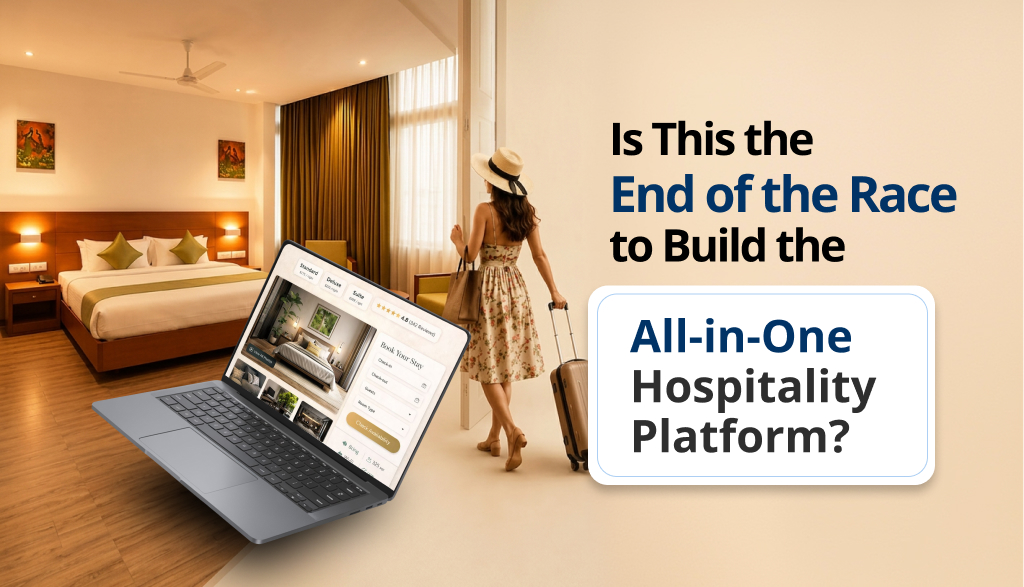
Why well-capitalized companies are buying the hotel technology stack—and why connected specialists may offer the better model.
For much of the past decade, one of the clearest strategies in hospitality technology has been simple: buy the missing pieces.
A company with a property management system acquires a booking engine. A revenue platform adds distribution. A software group buys a PMS, a channel manager, payments, guest communication and business intelligence. The products are then presented as an increasingly comprehensive hospitality platform.
The logic is attractive. Hotels want fewer technical problems, less manual work and a more consistent flow of data. If one provider can supply everything, integration should become easier.
That, at least, is the promise.
But a recent decision by Mews raises an important question. After years of acquisitions—and shortly after raising another $300 million—the company chose a specialist partner for one of the most important remaining parts of its platform: channel management.
Could this mark the beginning of a different model—one in which the best hospitality platform is not the company that owns everything, but the ecosystem that connects the best solutions?
The consolidation of hospitality technology
The movement towards broader hospitality platforms has been visible for approximately five to eight years and remains very active in 2026.
It is driven by several different types of well-funded buyers:
- Software groups assembling end-to-end suites. Access Group has expanded its hospitality portfolio through acquisitions including Guestline, SHR and STAAH. Zucchetti acquired easybooking in 2025 and, in July 2026, announced an agreement to acquire a controlling stake in Grupo Hive, including Omnibees, subject to regulatory approval. Its stated objective is an integrated ecosystem spanning hotel management, distribution, payments, data and direct sales.
- Hospitality companies expanding from a strong core product. Mews started with a cloud PMS and expanded into adjacent areas such as POS, revenue management, events and data analytics. Shiji has brought PMS, POS, distribution, payments, guest engagement, content and data intelligence together under the Shiji Platform.
- Asian technology groups building internationally. South Korea's Yanolja has expanded its hotel technology capabilities through businesses such as eZee Technosys and, in May 2026, InnKey. It is developing an operational ecosystem for properties ranging from small accommodation providers to international hotel groups.
- Commercial-platform consolidators. Lighthouse expanded from market and pricing intelligence into channel management through its acquisition of Stardekk, and into direct-channel marketing through The Hotels Network. Its focus is not the complete operation of a hotel, but an increasingly broad commercial platform.
- Large travel-technology and specialist software portfolios. Amadeus made its $1.52 billion acquisition of TravelClick in 2018 as part of its journey towards becoming an end-to-end hospitality technology provider. Agilysys has built a broad operating platform for resorts and complex hospitality businesses. Constellation Software's Juniper Group follows a different model again: it owns a growing portfolio of travel technology businesses while explicitly allowing them to operate independently.
These companies do not all pursue the same strategy. Some are attempting to create one technically integrated platform. Some are assembling complementary products under one commercial umbrella. Others are building investment portfolios whose companies remain largely autonomous.
Nevertheless, they reflect the same larger trend: fewer, better-capitalized groups own an increasing share of the technology used to operate, sell and optimize hotels.
Why the all-in-one promise is compelling
The attraction for hotels is easy to understand.
Hospitality technology has historically been fragmented. A hotel may use separate systems for property management, distribution, direct bookings, revenue management, payments, point of sale, housekeeping, guest communication and reporting. Every connection must be implemented, monitored and maintained. When something fails, it is not always clear which provider is responsible.
An all-in-one platform promises:
- One supplier and one commercial relationship
- Fewer interfaces to implement and maintain
- More consistent data across departments
- A common user experience
- Faster support and clearer responsibility
- Simplified procurement, onboarding and training
These are real benefits. Hotels do not want a collection of disconnected tools. They want technology that works as one system.
However, there is an important difference between one connected experience and one company owning every component.
Ownership does not automatically create integration
Acquiring several software products is much faster than building them—but buying them does not make them one system.
Acquired products may continue to use different databases, data models, user accounts, interfaces and development frameworks. They may have separate support teams and contracts. Years of technical work can be required before data and workflows move seamlessly between them.
In some cases, the result is not a true platform but a portfolio of products presented under one brand.
That does not make the products bad. Each may be very capable within its own domain. But hoteliers should not assume that a common owner guarantees deeper integration than two independent specialists can provide through well-designed APIs.
The relevant question is therefore not simply, “Can one company sell us everything?” It is:
Does the technology function as one connected environment while preserving the hotel's access to data and freedom of choice?
Convenience can become dependency
Buying the complete technology stack from one supplier can appear convenient at the beginning. Over time, however, it can create substantial technical and commercial dependency.
If the PMS, channel manager, booking engine, payments, revenue management and guest data are tightly bundled, replacing a single component becomes difficult. A hotel may find a specialist solution that performs one function better, but introducing it could require changes to several other systems, a new payment setup, data migration or renegotiation of the entire contract.
The hotel may then continue using an inferior component—not because it is the best solution, but because separating it from the wider platform would be too expensive or disruptive.
This is vendor lock-in. It can reduce competition and weaken the hotel's negotiating position. More importantly, it can limit future innovation. Hospitality technology evolves quickly, and hotels need the ability to adopt better solutions as guest behaviour, distribution channels and business models change.
The strongest platform should therefore make the hotel more flexible, not less.
Mews and SiteMinder: a significant counterexample
Mews is an especially interesting case because it is not opposed to acquisitions. Mews Ventures has repeatedly acquired companies to expand the platform, including Bizzon for POS, Quotelo for events and group sales, Atomize for revenue management and DataChat for AI-powered analytics.
In January 2026, Mews raised $300 million at a valuation of $2.5 billion. It clearly has the financial capacity and ambition to continue expanding.
Nevertheless, for channel management, Mews chose partnership.
In May 2026, Mews and SiteMinder announced Mews Channel Manager—Powered by SiteMinder. SiteMinder's distribution technology will be embedded within the Mews operating environment, allowing hotels to manage distribution without leaving Mews. At the time of the announcement, almost 3,000 hotels were already using the two systems together.
Mews founder Richard Valtr summarized the decision in one sentence:
“When something is already the best in the world, we don't try to rebuild it.”
This is more than a conventional interface between two software products. The stated objective is a native experience: SiteMinder provides the specialist distribution infrastructure while Mews presents it within the hotel's operating environment.
The decision does not prove that the race to build broad platforms is over. The partnership does not mean that Mews has abandoned development or expansion through acquisitions. But it demonstrates that even a well-funded, acquisition-oriented company can decide that deep cooperation with an independent specialist is better than owning the entire stack.
A new definition of “all-in-one”
Perhaps the industry needs to separate two ideas that have often been treated as identical.
The traditional definition of all-in-one is based on ownership:
- One company owns every product.
- The hotel buys the full stack from that company.
- Integration takes place inside the vendor's ecosystem.
An alternative definition is based on connectivity:
- Independent specialists remain focused on their respective domains.
- Their systems are deeply integrated through open, reliable interfaces.
- Data moves across the ecosystem without manual intervention.
- The hotel receives one connected workflow while retaining the freedom to change individual components.
This model can combine the convenience of an integrated platform with the innovation and expertise of specialist providers.
Of course, partnership alone does not guarantee openness. A natively embedded solution can also create dependency if alternative providers are technically blocked, data is difficult to export or contracts make switching impractical. The decisive test remains whether the hotel retains genuine choice.
It also creates healthier incentives. A specialist channel manager must continue to be excellent at distribution. A revenue management provider must keep improving its pricing technology. A booking engine must remain competitive in conversion, accessibility and direct-booking functionality. Each company succeeds because its product performs—not simply because it is bundled with the rest of the stack.
What hotels should ask before choosing a platform
The debate should not be reduced to “suite versus specialist.” A well-integrated suite may be the right choice for one hotel, while a connected collection of specialist systems may be better for another.
Before committing to either model, hotels should ask:
- Can each major component be replaced independently?
- Does the platform offer documented, modern APIs?
- Who controls the hotel and guest data, and can it be exported in a usable format?
- Can the hotel connect alternative providers without commercial or technical restrictions?
- Are the products genuinely integrated, or merely owned by the same group?
- What happens to integrations and data if the commercial relationship ends?
- Does the contract create dependencies through bundled pricing, payments or long notice periods?
The answers reveal whether a platform simplifies the hotel's technology—or quietly limits its future choices.
Is the all-in-one race ending?
No. Consolidation in hospitality technology is continuing, and companies with deep pockets will keep acquiring specialized products. Scale, shared data and broader product portfolios can generate significant value for both providers and hotels.
But the Mews–SiteMinder partnership may signal that the limits of the ownership model are becoming clearer.
Hotels do not need one company to own everything. They need their systems to work together. Those are not the same requirement.
The winning hospitality platform may therefore not be the one that builds or buys every component. It may be the one that brings the best solutions together, gives data a reliable path between them and allows hotels to remain free to choose.
At Cultuzz, we believe this is why a neutral connectivity layer matters. The hospitality industry will remain diverse: hotels will use different property management systems, channel managers and booking engines, while distributors and emerging AI channels will require consistent access to live inventory, prices and booking functions.
The future of hospitality technology should offer the advantages of integration without the restrictions of dependency.
One connected experience does not require one owner.